

The Future of Marketing, as Seen at Cannes Lions - Harvard Business Review
This article from the Harvard Business Review is a great review of what the advertising industry is dealing with as it attempts to disrupt itself and remain relevant and engaged with potential consumers. That said, there is far more subjectivity, these days, to what is considered a "quality" campaign. This years Cannes Lions proved that point.
That said, what Cannes did show us is that even the most irreverent advertising can be successful. HBR points out how:
There are a few things that brands can do to take advantage of the emergence of these new open-system species.
1. Adapt your business models to exploit new opportunities rather than try to apply your existing one. As discussed, open-system species are agile in part because they see opportunities and create new models to go after them.
2. Take more control. It used to be that brands needed an agency to communicate with customers. Today, with the falling price of media and the real time nature of the two-way conversation with consumers, brands can do more of this themselves. Some of the best-known brands including Patagonia and Apple are building their own in-house strategic agencies, taking control of strategic and creative leadership while using an open system to collaborate with great outside talent. Those brands realize that one of their most important assets is their relationship with consumers. There will still be a place in the ecosystem for lots of players and collaboration, including agencies, but brands increasingly can take the lead.
3. Seek out great ideas wherever they are. Companies and their brands need to get away from idea myopia, the notion that one outside organization, usually an agency, must be the sole creator of marketing ideas. Not only do your most passionate fans have great ideas and the tools to communicate them but there are ideas to be found from retailers, distributors and other outside partners. Likewise, internal team members have some of the best creative ideas but are sometimes afraid to participate.
World Cup Pushes Social to New Heights
Advertising data website Warc states that "[a]lmost half of all connected TV viewers around the world are now multiscreening...with the FIFA World Cup." The global Connected Life study conducted by TNS found that 48% of people who watch television in the evening also participated in secondary digital activities such as social media, shopping and checking emails (75% watch daily and as many eat their evening meal during this time as well).

TNS also found that during the FIFA World Cup these people attempted (where possible) to placeshift their viewing experiences, leveraging multiple screens and locations. This "always on" ability for viewers to experience the World Cup has (rather successfully) lead to a far heavier social conversation presence on social media channels such as Facebook and Twitter:
"[t]he semi-final that saw host nation Brazil lose heavily to Germany [which] drove a record number of interactions on Twitter, the Guardian reported: the 35.6m tweets during that game far surpassed the previous high of 24.9m during the 2014 Super Bowl. At one point there were 580,166 tweets per minute,...[a] new record."
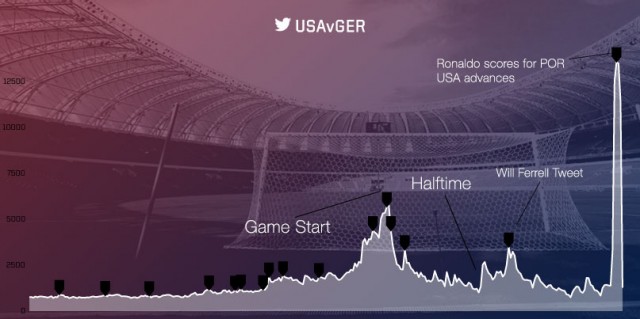
US Soccer fans took to Twitter to comment, support and share their feeling and experiences of the match against Germany.
Similarly, the USA soccer team, while trying to make it past the Group Stage against Germany saw a heavy social media presence. During the match, which included a few substantial events such as a tweet from Will Ferrell or the goal from Portugal which guaranteed a US presence in the round of 16, it was clear that fans of USMNT leveraged their second screens to comment on the situation.
So what is the impact for marketers and advertisers? Commenting on the findings, Matthew Froggatt, Chief Development Officer at TNS, noted that "the growth in screen-stacking and online TV viewing is huge, particularly in the Asian markets [in which 32% of the population consume content on a digital device]"
Advertisers would, he noted, have to adopt a more integrated online approach in order to engage consumers.
Upfronts 2014: Where's The Funny?
A sad state of affairs for TV-based comedies. The Upfronts for the 2014-2015 television season is quite different from last year's high-octane announcements of the return of two comedy stars Michael J. Fox and Robin Williams (The "Michael J. Fox Show" and "The Crazy Ones" respectively) among the litany of new (heavily advertised) comedy options ("Brooklyn Nine-Nine", "About a Boy", "Community", etc.).
The 2014-15 schedule has traded in new comedies (and canceled a few), to make room for dramas and (oh good) more reality television.
Network brands are shrinking their aggregate broadcast time devoted to comedy despite the overwhelming successes of Community (whose sixth season was canceled, but was brought back by popular demand for their 5th season), The Big Bang Theory, and Modern Family.
It is important to remember that comedy is alive and well, just not on Network television. Runaway successes of Louie, Girls, Veep and Orange is the New Black provide insight that there is high demand for these types of shows, but the highly involved, but small audience size make it less profitable for ABC, NBA, FOX and CBS. Due to the financials, the genre has shrunk, and new, and established, content has, and will, shift to cable, premium channels or online (Hulu, Netflix or Amzon).
It is a shame that content is judged by some discounted cash flow calculation and ROI algorithm, but that is the nature of television; always has been.
What is worrying is the fracturing nature of distribution channels for content in a world where content distributors such as Comcast and Verizon do not allow for easy consumption across all platforms.