

One Year In, Can F1 Make it in the USA?

© Sutton Images via: Formula1
Drivers such as Senna or Schumacher, teams like Lotus or Ferrari, courses such as Imola or Silverstone, and even course turns like #17 La Rascasse in Monaco are all names that evoke incredibly deep emotion in fans of F1 racing throughout the world. But in the U.S., these names most likely mean nothing…until NBC showed up.
Like it or not, Formula 1 (F1) is coming to the United States. Between NBC’s heavy investment in showing all races, Rush, Ron Howard’s F1 movie chronicling racing legends Niki Lauda and James Hunt, as well as a salivating lust by luxury brands to reverse their post-recession slow-down and grow their addressable market, F1 is set to deliver a return on investment to the FIA (F1’s governing body), NBC, marketers, and luxury brands.
NBC (and its property NBC Sports) heavily promoted the celebrity-studded, luxurious, and well-known Monaco Grand Prix as it rolled out its coverage, and the results were impressive. Viewership of the Monaco Grand Prix jumped 241% over 2012 when it appeared on SPEED. Coverage in two highly coveted demographics (P18–49 and P25–54) saw massive triple-digit growth.
After a $3 million deal in which NBC acquired the rights to air the races in the United States, F1 was shown in the USA for the first time on NBC Sports and will broadcast all 20 races. This $3 million deal had NBC replacing the Speed Network as the broadcaster after 17 years.
In an interview, John Miller, President of NBC Sport Group, stated that “Formula 1 is a perfect fit for the NBC Sports Group as it provides content across three platforms – broadcast, cable, and digital – for nine months a year with more than 100 hours of premier programming annually.”
NBC has shown its desire to pull a rather esoteric European sport into its portfolio in the United States, but the question remains: is it worth it? All major players in the deal must see value: the FIA (F1’s governing body), drivers, all network channels, and brands.
The Monaco Grand Prix on NBC was the most watched F1 race on TV in six years. Thanks to Fast National data provided by The Nielsen Company we know that nearly 1.5 million viewers watched it, making it the most-watched F1 race on U.S. television in six years, and up 241% vs. last year’s race, which aired on SPEED.
NBC racked triple-digit increases vs. SPEED’s airing last year among two key demographics, adults P18–49 (461,000 vs. 127,000, up 263%) and Adults P25–54 (674,000 vs. 160,000, up 321%).
In order to promote the race, NBC developed two 30-second promotional spots with creative that focuses on the speed of F1 and aims to appeal to the upscale sports fan by highlighting its international appeal and cultural significance. The spot currently is running on NBC Sports Group properties such as Golf Channel, NBC Sports Network, and NBC Sports Regional Networks.
Based on Nielsen data, demographics of the U.S. F1 audience provide synergies for all parties bringing F1 to the U.S.: wealthy, worldly, and educated with disposable income. This audience matches the desired audience of the sponsoring brands, provides viewership for NBC, and provides the FIA with fertile ground to grow the sport’s brand, which sells millions of dollars in licensed merchandise across the multitude of teams that compete in the circuit.
The core audience being discussed in this small case study is male, living mostly in the Northeast as well as the South, educated, and overindexing in the early 20s, 30s, 50s, and 70s. Furthermore, they live in urban and near-urban environments, have high earning potential, on average, earning more than $70,000 per year, and watch four or more races per year.
There are two things to keep in mind as F1 finishes its initial year in the U.S.: what will cause F1 to succeed in the US, and without an American driver, will the luster of fast cars and luxury timepieces wear off on the American audience?
Answering the first question: the network’s sales team signed a deal with Rolex that makes the watch company the presenting sponsor of all of its F1 coverage. It also picked up advertising commitments from ExxonMobil, Mercedes-Benz, Pirelli, John Deere and other companies. So, no apparent issues with getting sponsors; NBC must be doing a good job of bringing the audience. But, with no American driver, is this all for naught? Mario Andretti believes that if F1 is to succeed in the U.S. there must be a U.S. driver. Andretti might know a something about this: he was the last American to find any success in F1, which ended in the late 1970s. Furthermore, with the revival of the American Grand Prix held in Austin, TX, the FIA is attempting to bring the sport closer to Americans. But, with no major U.S. favorite, some fans might have a hard time switching from IndyCar or even NASCAR.

© Sutton Images via: Formula1
F1 in the United States has seen a rather resplendent return thanks to the work of NBC and its associated media properties, and it seems that NBC has a strong core demographic tied up with the airing of these events (which usually overlap the Sunday morning news magazines). But for F1 to stay relevant, it needs a strong continuing American presence and marketing efforts. The goal is not to satisfy current fans, but to attract new ones and to bring wealthier spectators to the doors of the marketing partners such as Rolex and Mercedes-Benz.
Currently there is no vested interest for the new American fan, nothing that might make him switch from other motor sports or engage in a new one. With only the addition of F1 onto the nation’s airwaves as well as one race in Austin, TX, NBC has a great deal more to do to attract fresh viewers.
By no means are the Nielsen data an aberration, but is it possible that without a consistent message, F1 will remain a core-fan sport only? The Monaco Grand Prix was marketed with celebrities, high-end consumer cars, and other luxury items without displaying the pedigree and pomp of what makes Monaco such rich and hallowed ground for both racers and true fans of the sport. After the glitter falls to the ground and the music is over, we are left with a race–is that enough to keep fans engaged?
To add a personal note, I am thrilled that F1 has come back to America with such force (a triple-digit growth in viewership is fantastic), but I am concerned with its maintenance. I will always be a fan and I will go to the ends of the Earth to watch the races, but it seems like that tacky NBC ad that the FIA is using to grow the sport within the borders of the United States means removing the aspects that make it truly unique: it’s body-punishing, high-octane burning, physics-defying, rude, innovative, engine-shrieking, European panache.
This article originally appeared in Hill Holliday's "Thinking" section.
It was written by Christopher van der Lugt.
Americans Want to Pull Back from World Stage
Nearly half of Americans want to pull out of the world stage.
Source: WSJ
With all that is going on within the boundaries of the United States, it should not come as a complete surprise that American's are not so interested in being a main fixture on the world stage as in years passed (additionally, do we need to be?). There is no more cold war, conflicts in which American forces are used in the past 15 years have been primarily out of self-interest (though America's engagement in the Balkans as well as in Afghanistan was warranted in this author's opinion), and modern warfare has changed across tactics, theaters and goals.
Much like an article I wrote a few weeks back, Americans are in a malaise, a widening economic divide, limits on opportunities, and the growth of China are certainly reasons that could contribute to this thinking. "The Myth of the American Decline" might not be believed by all, but certainly it is compelling enough to warrant a discussion. But, we have to face facts, there is just no global cultural appetite for American hegemony.
Certainly the United States is a one of the most influential global actors, but there is a belief that the nation, internally, is broken and needs fixing. It cannot be coincidental that Americans wish to see a retreat in their nation's global involvement, especially when so many of them want to see change happen inside the borders.
What do you think? Post a comment below, should America pull back its activities globally? if so, how/what/where?
Via WSJ
One in Five African Adults Work on Farms
Gallup released a detailed research report that stated that 1 in 5 sub-Saharan African adults work on farms. This fact has broad implications for international development, GDP, the nations' Current Account and internal growth of industry.
Gallup interviewed 31,000 adults throughout Africa and found that these 20% of African adults are working on farms, causing little to no upward mobility for families of the workers since, by in large, the African workforce is older and less educated. Taking the 20% figure, and extrapolating it to the region's population, it means that 84 million adults are employed by the industry.
In order for the industry to thrive in Africa this 20% population (84 million) will need to grow, but it will need to grow in a more sustainable, future-forward way so as to implement new methods, technology and engage in partnerships to assure that the industry can yield enough to feed the sub-Saharan region, and eventually post a surplus to trade with.
An "out of touch" labor force working on farms means that implementation of modern agricultural methods and technology will lag. These advances would increase crop yields, provide methods to better survive inclement conditions, as well as bear fruit that would become a source of export.
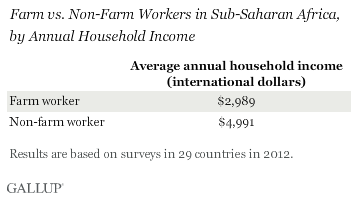
Non-farm workers make early twice as much in a year.
In order for the industry to grow, and sustain itself, it must begin to find ways to compensate its laborers better that begins to march closer to non-farm workers. Currently a farm worker makes about half as much as non-farm workers. This might provide enough purchasing power within the agricultural regions in which they work, but it is probably not enough to sustain growth and development in a way that can change an industry.
There was an interesting positive note: families of farm workers had a higher average number of children within the household. As the sectors' labor force is getting older, an above average amount of young blood entering the work force (maybe entering agriculture) could rejuvenate the industry, force it to adopt more disruptive technologies and force a change from subsistence to surplus farming. This would mean more partnerships with NGOs, industry and governments to ensure that no adverse policies, tariffs or any other impediments would prevent growth.
The Food and Agriculture Organization (FAO) mentioned in a report that investing in the "enhancement of agricultural productivity and engagement of youth, smallholder, and family farmers are among the key priority areas" The FAO have identified that these policies are important to "accelerate agricultural transformation and eradicate hunger in the region."