

UPDATE: The Cynicism of the USA; Our Decline and Fall? (Part 1)
Via The Boston Globe
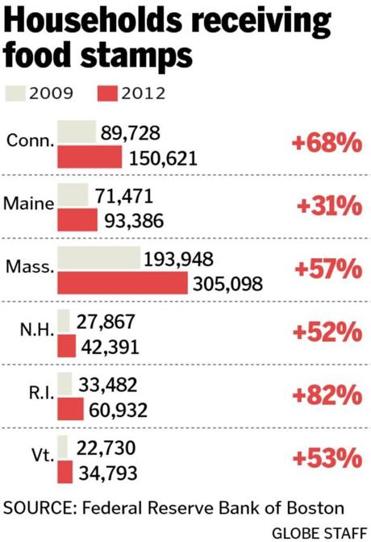
Curious. In this morning's Boston Globe there was an article titled, "Middle class eroding, gap widening in Bristol, R.I." which speaks directly to the issues that were mentioned in yesterday's blog post, "The Cynicism of the USA; Our Decline and Fall? (Part 1)". The article states:
"Like many other places in America, Bristol is increasingly a community of extremes, home to both great wealth and a shrinking middle class as more residents slip closer to poverty. Nearly one of every 10 households in Bristol County uses food stamps, more than double the number just a few years ago, representing one of the largest increases in New England."
Unemployment Rates for Bristol, RI and the Nation.
More than one third of households that are using the available food pantries (located about two miles away from Poppasquash Neck, where a mansion just sold for $5.2MM) have more than one wage-earner.
You can see that Bristol has a seasonal trend with their unemployment rate (blue line, and not surprising, it is a vacation destination), but it is consistently higher than the national average (red line). Note however that the lines are starting to separate indicating a growing inequality.
The Cynicism of the USA; Our Decline and Fall? (Part 1)
CIvic Virtue
The United States has entered a slump, but one that is not able to be programmatically fixed like other cultural-economic events such as the Great Depression, the bond craze fall-out in the mid-1980s or the bursting of the Tech Bubble in the 2000s. I am actually talking about a deep-seeded pit in the stomach, so severe that people are not sure how best to process their feelings. Our entertainment industry has never been a better barometer of the national mood, or zeitgeist, than when we regard it as a mirror to analyze the current culture of the nation. Remember the 80s? Movies during that time had a clear theme of exploration and exceptionalism, as an industry our entertainment division is tapped into our consciousness. But lately this mirror has started to project more than reflect: movies are getting far more graphic, wrestling and boxing have given way to the supremely more violent UFC, and headlines are made when a celebrity releases a sex tape, implodes on national TV or enters rehab, not for reaching out to the impoverished making lives better, or (ironically) not for exceptional work within their craft.
Lacking that ability to articulate the larger nature of popular displeasure - but broadcasting our displeasure anyway - has opened up opportunities for entertainment and music to reflect our overarching schadenfreude.
This is not the first time that history has reported on a general popular malaise. Indeed nations can swing in and out of these slumps rather often and quickly. It is when it becomes entrenched (as I believe it has in the USA) that we have to worry about the future. The last empire to fall victim to this was that of the Romans.
"The Oath of the Horatii" Jacques-Louis David's 1784
The painting was an 18th century touchstone on the ideals of "civic virtue" which became foundational political theory.
Source: Wikimedia
Historian Edward Gibbon penned this theme about Rome in his book "The History of the Decline and Fall of the Roman Empire" (publication dates: 1776-88). He attributes the long decline of the Roman Empire to a growing sense of malaise, loss of Civic Virtue and the empire's outsourced security to paid (stateless) mercenaries -- not to mention a whole host of other internal political and social issues.
However, it is the ideal of civic virtue and the related general malaise that I want to focus on. Gibbon states:
The decline of Rome was the natural and inevitable effect of immoderate greatness. Prosperity ripened the principle of decay; the causes of destruction multiplied with the extent of conquest; and as soon as time or accident had removed the artificial supports, the stupendous fabric yielded to the pressure of its own weight.
Through the decline of the Roman Empire, the multitude of historical accounts mention theories such as widespread malaise of the populace, outsourced military protection to stateless entities, agricultural stagnation (and lack of agricultural innovation) and a highly debased currency which started all the way back with Nero. Of these possible cause of decline, one theme does seem to pull through, and that is the theme of civic virtue, or the ability for society to instantiate habits that are deemed beneficial to the larger society. Ultimately, the situation that the Roman Empire found itself in saw many functional attributes that did not allow for agency within its populace and for civic virtue to erode.
Through the slow erosion of civic virtue was the increased need for security as levels of wherewithal increased. Rome disintermediated much of their workforce through outsourcing allowing the richer classes to retain more money and forced the poorer classes to look for work elsewhere.
As one would expect with a destabilizing empire the wealthy began to find ways to maximise and protect their wealth. They imposed policies through the Senate that would create, facilitate and enable laws to protect their way of life, how that life was funded and how that funding was protected. Hence, the rich get richer and the poor got less.
The widening devide between the rich and poor is something that we are experiencing in the USA. This blog post is one in a series of posts that speak to the theme of the loss of American Exceptionalism and focuses on the widening gap between the "haves" and the "have-nots" and its manifestation in our entertainment culture.
Widening Gap
Gini coefficient by OECD country (where available)
Source: OECD
Let us begin this thinking by reviewing a graph (left).
The Gini Coefficient is a measure of dispersion of income distribution of a nation's residents where "0" is perfect equality (all residents make the same income) and values that approach "1" show greater and greater inequality.
I have ranked nations into tiers, where tier 1 is closest to '"0" and tier 4 is closest to "1". Additionally, the countries along the x-axis are rank ordered from 0 to 1, left to right. It is interesting that the US is ranked between India and Turkey -- two of the more corrupt countries, known to be more unequal in their distribution of wealth.
Tiers 1-3 show a pretty stark difference in countries' income distribution, but tier 4 certainly shows the runaway nature of income inequality. Developing countries will tend to be out of balance as a wealthy class will form first and (ideally) expertly develop industry to begin to develop a middle class that ultimately distributes the wealth more evenly across the country (Slovenia is a great example of that, and it's not a surprise that they are ranked #1 in the list). Perhaps this is the sign of a maturing empire, but those empires that enabled such loss of civic virtue, and did not step in to correct and guide society, ultimately lost out to more disruptive empires (Rome, Russia, France, Macedon, etc).
As the wealthy become wealthier, and the gap widens, there is less of an expectation that the renowned "American Dream" can be attained. It takes more money than ever to differentiate ourselves through education, abilities to network, and even clothing. Professional (and alumni) networks are becoming more siloed and insular making it harder for those with less to succeed in affording what once was the key differentiator: education.
Loss of civic virtue along with the increasing disparity between the "haves" and "have-nots" leads to rampant pessimism and rampant pessimism needs an ally. People need to see their discontent in culture and culture has answered in spades: Flawed and tragic hero television shows (Mad Men, Breaking Bad, House of Cards, etc), schadenfreude in pop culture figures' personal implosion, 24hr news coverage, and an overall lack of hope contribute to fueling the fires of our despair: we believe we cannot be great and those that society deems great are met with rabid excitement when they fall from grace.
It is clear that we are not a happy nation, but we are not allowing ourselves to show our discontent, instead we fester and brood; anyone can tell you that that is not a healthy solution to a major underlying problem.
Frank Underwood, Comcast and the FCC

House of Cards Season 2 began again on February 14, 2014
If you haven't watched the second season of "House of Cards" (or, gasp, any of the show), be glad that Netflix just paid Comcast a lot of money to ensure that will be able to continue to do so in high-definition and 4K.
For those who are uninitiated, "House of Cards" is a show produced and distributed by Netflix; it is a take on a British show of the same name (1990). Our American version features Kevin Spacey and Robin Wright as Frank and Claire Underwood, two conniving, and deceitful Washingtonians and their ultimate quest for vengeance, power and glory stemming from those who betrayed Frank in the first episode (more about the show can be read here and watched here).
This isn't a post about the show, but more chatter about the overall way that we are (globally) consuming content (in all forms) and how providers, creators and consumers are all intertwined (for good, and for evil).
With the recent news that Comcast plans to purchase Time Warner Cable, as well as the net neutrality controversy in which Netflix agreed to pay Comcast for better bandwidth for content delivery to Comcast subscribers, I believe that the dam is beginning to crack, indicating a sea change in content delivery protocols, methods and laws for delivery across all channels and platforms.
Some might welcome this change as a necessary evil for the overall increase in quality, speed and content that the public seems to clamor for (especially in 4K). Others will most definately see this as an affront to net neutrality and an overreach by a (despised?) major corporation that has begun to acquire content providers such as NBC.
This, however, is a sweetheart deal for Time Warner Cable who has struggled for years to be seen as a company that provides consistent, high-quality service to its subscribers (which it doesn't). Recent polling conducted by BrandIndex (a subsidiary of YouGov) shows some interesting things.
As one would expect, Comcast's "reputation" and "satisfaction" metric falls sharply, but in an interesting turn, Time Warner Cable's metrics sharply increase.
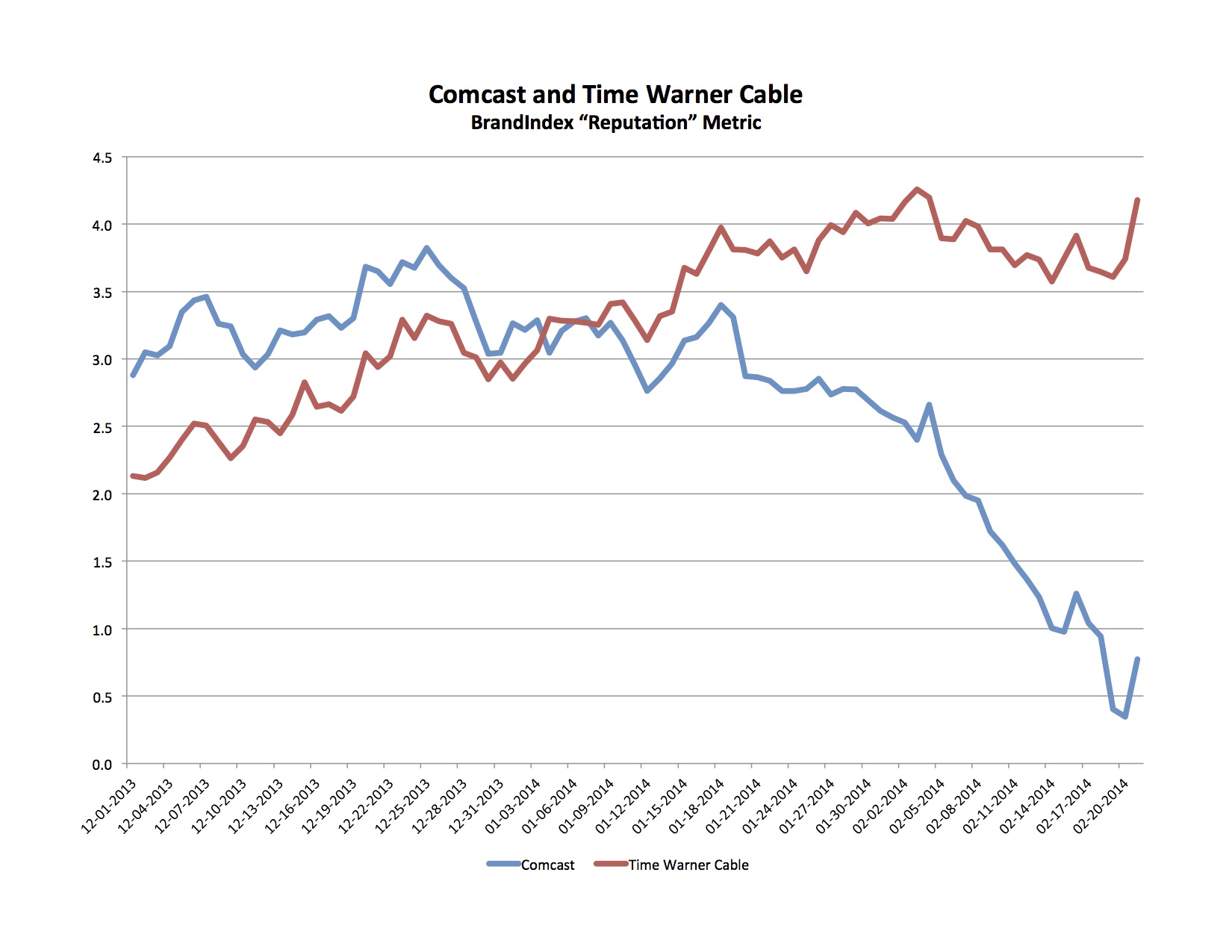
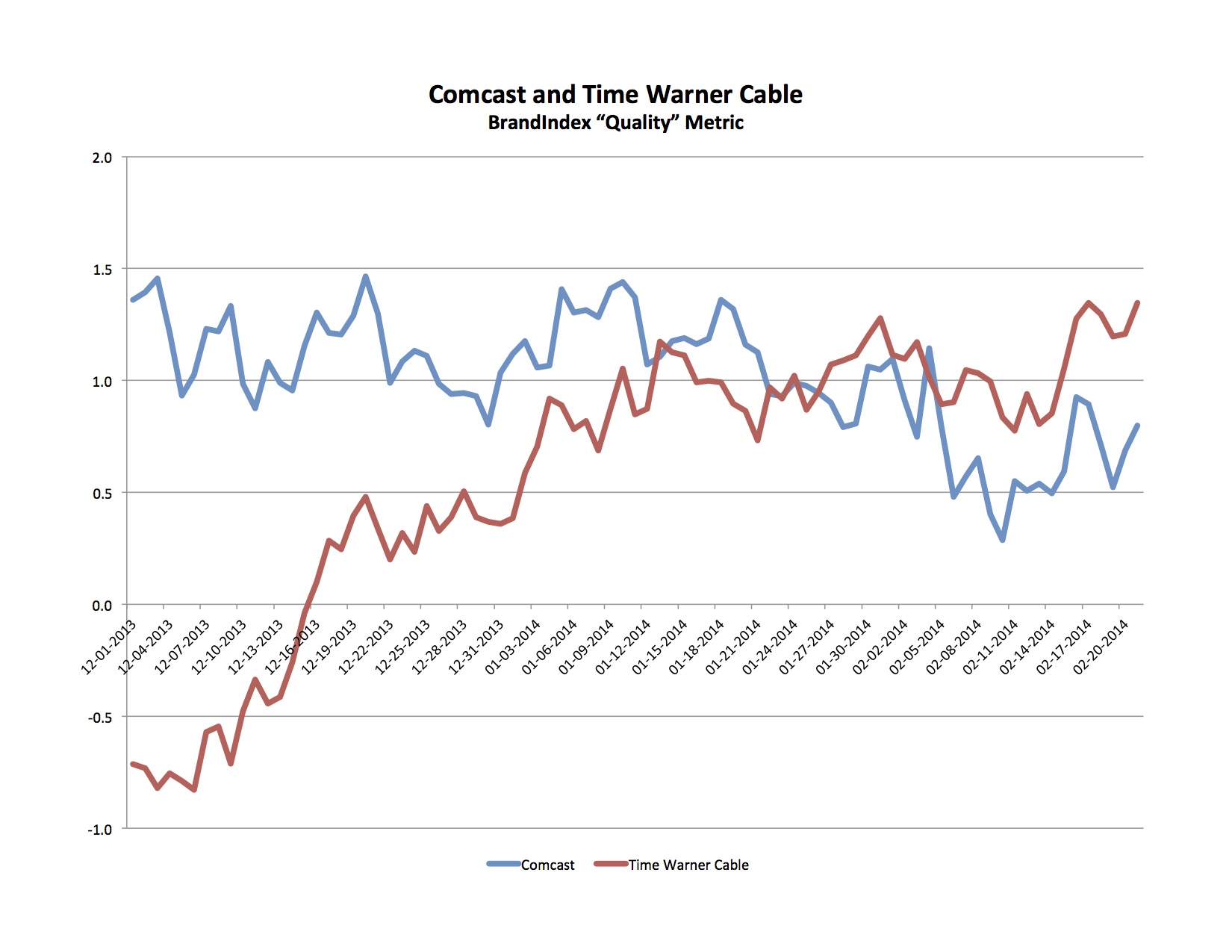
So the acquisition is good for Time Warner, but has the opposite effect on Comcast. But it doesn't matter since, as Gigaom mentions, it's all about the broadband and its associated revenue stream:
According to UBS estimates, the combined company could see its consumer data-only revenues go from $17 billion at end of 2013 to about $23 billion by end of 2018. Voice revenues go from about $6 billion at the end of 2013 to $6.6 billion at end of 2018.
Really. Who cares if I am a happy subscriber -- just make sure I continue to pay.
Netflix had to pay Comcast in order to protect high-quality streaming - there was no other way to ensure that the content, for whom Netflix has begun designing around the viewer, makes it into the home.
It is critical that Netflix's content be delivered: it retains customers and makes the comany money. Netflix is starting to see that it has reached the innovators, early adopters and early majority and is starting to flatten in growth (or at least it is attempting to think about the very near future when that happens). It is a public company and needs to ensure that it's cash flow remains robust and that it can grow its market capitalization and attract investors. in order to do that it needs to innovate; House of Cards was just that innovation it needed as a proof of concept. Since the first season aired in 2013 (and was announced in 2012), Amazon has also gotten into the content creation service releasing Alpha House, Betas and, a whole slew of new shows in 2014.
So what does "House of Cards" tell us about what is actually going on in the content creation and content distribution industry? Well, unlike today's ability to binge-watch a season or two of a show, I guess you will just have to tune in later and find out.